When he deleted messages and told me his phone had automatically cleared them.
“What problems?”
He looked at the nurses.
Neither woman moved.
Then he looked back at me.
“Our fertility problems weren’t really yours.”
The fetal monitor continued beating out my baby’s heart beside us.
One hundred forty-seven.
One hundred fifty-one.
One hundred forty-eight.
I listened to each number as if they were coordinates guiding me through a storm.
Nathan continued.
“I convinced Dr. Keene to make it look like there were concerns with your ovulation.”
My mouth went dry.
“What?”
“The first rounds were never supposed to work.”
For a moment I genuinely did not understand the words.
Then I remembered.
Fourteen months of appointments.
Charts.
Blood draws.
Ultrasounds.
Negative pregnancy tests.
The morning I sat on the bathroom floor holding a white plastic stick with one pink line while Nathan crouched beside me and whispered that we would keep trying.
The night I apologized to him because I believed my body was failing us.
The way he held my face and said, “Don’t ever apologize for something you can’t control.”
My fingers began trembling.
“You made me believe I was infertile.”
Nathan shook his head.
“Not infertile.”
“You made me believe something was wrong with me.”
“We needed IVF to create the opportunity.”
Opportunity.
Another carefully chosen word.
I almost admired his ability to make horror sound administrative.
Maya’s face had changed.
Professional calm was still there, but underneath it I could see disgust.
Nathan saw it too.
He snapped at her.
“Stop looking at me like that. You don’t understand the situation.”
She answered quietly.
“I understand enough.”
The door opened.
A broad-shouldered hospital security officer stepped inside, followed by a woman in dark green scrubs whom I recognized immediately as my obstetrician, Dr. Sofia Ramirez.
Dr. Ramirez took one look at my face.
Then at Nathan.
Then at Maya.
“What happened?”
I did not answer her.
I kept staring at my husband.
“You said three things.”
Dr. Ramirez frowned.
“Evelyn?”
“The third thing,” I said.
Nathan rubbed both palms across his trousers.
“No.”
A strange smile touched my mouth.
“You were brave enough to tell me the first two when you thought I was trapped.”
“Don’t do this.”
“Finish it.”
Security moved closer to Nathan.
He looked around the room.
At the nurses.
At the doctor.
At me.
And I saw the calculation happen.
Nathan had spent his entire adult life believing he could control the story if he controlled when people learned it.
He had chosen my labor because he wanted my body occupied by pain while he dictated reality.
Now the audience had changed.
And he hated it.
“Tell them,” I whispered. “Or I will spend the rest of my life wondering whether there was something worse than learning my husband married me while still sleeping with his ex, fabricated fertility problems, and tried to use me as an unwilling surrogate.”
Nathan’s eyes flashed.
“I didn’t marry you just for that.”
Just.
The word made Dr. Ramirez inhale sharply.
I leaned my head back against the pillow.
“Then why did you marry me?”
He said nothing.
And that was when I knew.
My stomach turned cold despite the sweat running down my body.
“Nathan.”
His face collapsed.
“I knew your medical history before our second date.”
Silence.
I could hear the air-conditioning unit above us.
I could hear a cart rolling in the hallway.
I could hear my own breathing.
“What does that mean?”
“I had access to the employee insurance database through Cooper Benefit Solutions.”
The room seemed to tilt.
Nathan’s company administered benefit packages for several large employers.
Including the engineering firm where I had worked when we met.
My fertility testing years earlier had been part of an unrelated hormonal evaluation.
“You accessed my medical information?”
“I saw enough.”
Dr. Ramirez said, “Mr. Cooper, I strongly suggest you stop talking until you have legal representation.”
Nathan ignored her.
Maybe he had finally crossed some internal line where silence no longer mattered.
“You were healthy. Your family medical history was clean. No clotting disorders. No major pregnancy risk factors. Diana needed someone who could carry safely.”
Maya whispered, “Oh my God.”
I could not blink.
“You chose me.”
Nathan said nothing.
“You didn’t meet me by accident.”
His face answered before his mouth did.
I remembered our first meeting.
A charity fundraiser in Baltimore.
Nathan bumping into me near the silent auction table.
The spilled champagne.
His embarrassed smile.
The joke about terrible catering.
The handwritten phone number on the back of his business card.
For three years, I had believed randomness had brought us together.
It had been one of my favorite stories.
Now I realized I had never had a love story.
I had been recruited.
“How long had you been looking?”
Nathan whispered my name.
“How many women did you look at before me?”
He looked down.
My chest constricted.
Dr. Ramirez moved beside my bed.
“Evelyn, your blood pressure is rising.”
I barely heard her.
“How many?”
Nathan finally answered.
“Five.”
The word broke something in me.
Not because five was a large number.
Because it meant there had been a list.
Somewhere, at some point, Nathan Cooper had looked at women like applications.
Age.
Health.
Family history.
Insurance.
Fertility.
And I had apparently won.
A laugh escaped me.
It sounded almost hysterical.
Nathan took a step toward me.
“Evelyn, listen to me. It became real.”
Security immediately blocked him.
Nathan stopped.
“Our marriage became real,” he insisted. “I did love you.”
“You loved me?”
“I still do.”
“You selected me from medical records because you wanted my uterus.”
“That isn’t fair.”
Every person in the room stared at him.
Nathan seemed to hear himself too late.
He closed his eyes.
I whispered, “What’s the third secret?”
His eyes opened.
“That was it.”
“No.”
I shook my head.
“You said three things you’ve been hiding. The affair and selecting me are connected. There’s something else.”
Nathan remained silent.
My next contraction hit.
This one was stronger than the others.
I cried out.
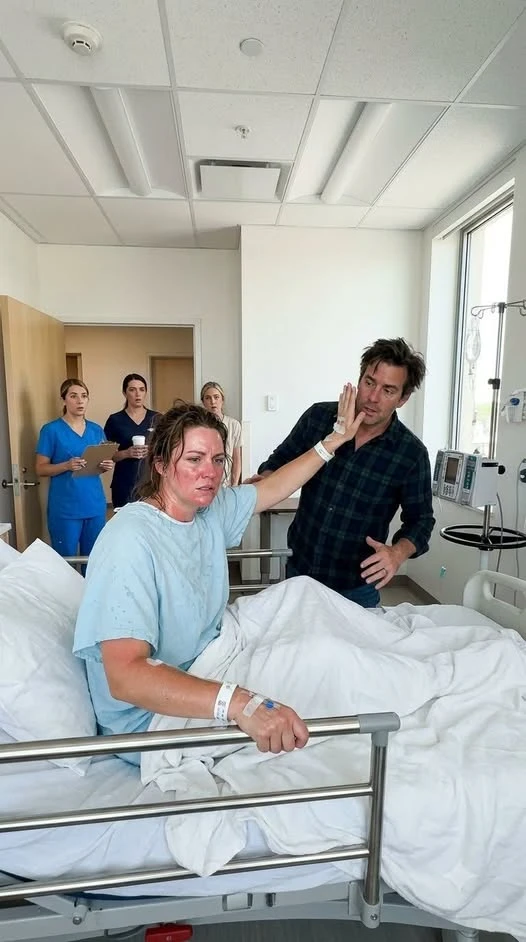
Dr. Ramirez moved immediately.
“Evelyn, I need you focused on me now.”
She examined the monitor.
“Maya, call labor team. She’s progressing faster than expected.”
The room suddenly became movement.
Gloves.
Trays.
Voices.
Another nurse entered.
Someone adjusted the bed.
The security officer told Nathan he needed to step outside.
“No,” I gasped.
Dr. Ramirez looked at me.
“He stays until he tells me.”
Nathan shook his head.
“Evelyn, please.”
I gripped the rail so hard my knuckles whitened.
“You don’t get to ask me for mercy in the room where you came to collect my baby.”
His face changed.
That was it.
Collect.
I had accidentally found the word.
Nathan looked toward the door again.
Then toward his briefcase.
The briefcase.
It had been sitting beside his chair all morning.
Black leather.
Gold clasp.
I had barely noticed it.
Now I could not stop staring at it.
“What is in the briefcase?”
Nathan did not answer.
Security followed my gaze.
“Sir,” the officer said, “don’t touch the bag.”
Nathan lifted both hands.
I looked at Dr. Ramirez.
“Please open it.”
Nathan exploded.
“You can’t search my property!”
The volume of his voice frightened the baby monitor into seeming quieter.
The security officer moved immediately.
“Sir, step into the hallway.”
“You have no right—”
“Now.”
Nathan looked at me.
The hatred in his eyes was so clean that it finally erased every remaining doubt.
Whatever love Nathan had claimed to feel had never been stronger than his need for control.
“It’s paperwork,” he said.
“What paperwork?”
He said nothing.
“WHAT PAPERWORK?”
My scream ended in another wave of pain.
Dr. Ramirez leaned over me.
“Evelyn, listen to me. You’re going to have this baby soon.”
But my eyes stayed on Nathan.
He knew it.
He knew there was no escaping the question.
Finally he whispered, “A voluntary relinquishment.”
I stopped breathing.
Maya turned.
“A what?”
Nathan’s voice became defensive.
“It isn’t what it sounds like.”
I almost laughed again.
“Then explain how signing away a newborn child isn’t what it sounds like.”
“It would establish Diana as the intended mother.”
“Using whose signature?”
Nathan looked down.
And suddenly I knew.
Not guessed.
Knew.
“You already forged it.”
His face went white.
The security officer’s posture changed immediately.
Dr. Ramirez looked at the second nurse.
“Get legal on the phone right now.”
Nathan raised his voice.
“I did not forge anything.”
“You just said you had a voluntary relinquishment.”
“Prepared. Not completed.”
“What did you sign for me?”
“Nothing.”
His eyes moved left.
He had always looked left when he lied.
Such a small habit.
Such a useless thing to notice during a marriage.
Such a valuable thing to remember while ending one.
“What did you sign?”
Nathan stared at me for several seconds.
Then something ugly entered his face.
Maybe he finally understood there was no version of that day where we went home together.
So he decided to wound me as deeply as possible before losing me.
“There are psychiatric records.”
I felt the room go silent again.
“What psychiatric records?”
“Dr. Keene referred you to someone after your miscarriage.”
“I never had a miscarriage.”
“I know.”
The air left my lungs.
Nathan continued.
“There are records saying you did.”
My fingers went numb.
“Why?”
“Because postpartum custody disputes can become complicated.”
Dr. Ramirez whispered, “Jesus.”
Nathan spoke faster now.
“There are notes documenting depression, emotional instability, fixation on pregnancy, paranoia, medication noncompliance—”
“I have never seen a psychiatrist in my life.”
“I know.”
“And you created records saying I had?”
His eyes were wet now.
Real tears this time.
But I felt nothing when I saw them.
“You were supposed to sign the papers voluntarily,” he said. “The other records were only protection.”
“Protection for whom?”
“For the baby.”
My body shook.
He had prepared to call me insane.
That was the third secret.
Not merely stealing my pregnancy.
Not merely stealing my marriage.
Nathan had built an alternate version of me on paper.
A woman who miscarried when she never had.
A woman who saw psychiatrists she had never met.
A woman who was unstable.
Paranoid.
Unfit.
He had constructed her piece by piece so that if I resisted after giving birth, he could point to a file and say my resistance itself was evidence of illness.
The brilliance of it was almost enough to make me sick.
If I accused him of switching embryos?
Paranoia.
If I said the clinic had lied?
Delusion.
If I refused to surrender the baby?
Fixation.
If I became angry?
Instability.
Nathan had not simply planned to take a child from me.
He had planned to erase my credibility before I ever knew I needed it.
Dr. Ramirez walked directly toward him.
“You need to leave my labor room.”
Nathan did not move.
“This is my child.”
“No,” I said.
He turned toward me.
I repeated it.
“No.”
“You don’t even understand the biology.”
“Neither do you.”
That stopped him.
Something about the sentence frightened him.
I did not know why yet.
Neither did he.
But within six hours, those four words would become the first crack in a lie far bigger than either of us understood.
Security escorted Nathan into the hallway.
He resisted only once.
Not physically.
He twisted back toward me as the officer guided him through the door.
“Diana is upstairs,” he shouted.
I stared after him.
There it was.
One final blade.
“She has an attorney with her! Evelyn, you need to be reasonable! This can still be handled privately!”
The door closed.
And for the first time all morning, my husband was gone.
I should have felt relief.
Instead I began to shake so violently that Dr. Ramirez ordered another nurse to bring warm blankets.
“Look at me,” she said.
I could not.
“Evelyn.”
My eyes finally met hers.
“You are safe in this room.”
“No.”
“Yes.”
“No, I’m not.”
My voice broke.
“My medical records were changed. My fertility clinic lied to me. My husband forged things. I don’t know what medication I’ve been given. I don’t know if the embryo inside me was what I consented to. I don’t know anything.”
Dr. Ramirez’s face hardened.
That was when she stopped speaking to me like a frightened patient and started speaking like a physician confronted with a potential medical crime.
“All right.”
She pulled her stool closer.
“From this moment forward, nobody gives you anything without telling you exactly what it is. We will document every medication. We will restrict your chart. Nathan Cooper is removed as your medical contact. Nobody receives information without your permission.”
“Can you do that?”
“Yes.”
“What about the baby?”
“The baby stays under hospital protection with you unless there is a medical emergency.”
“What if Diana has paperwork?”
“Paperwork does not give someone permission to walk into a delivery room and take a newborn.”
I started crying.
Not loudly.
The tears simply came.
Dr. Ramirez took my hand.
“You do not need to solve your marriage, genetics, the fertility clinic, or anything else in the next hour.”
“But—”
“You need to deliver safely. We can protect evidence afterward.”
Evidence.
My daughter had become evidence before she had even taken her first breath.
The thought almost destroyed me.
Then Maya leaned over the bed.
“No.”
I looked at her.
“She is not evidence first,” Maya said. “She is your baby right now. Whatever any test says later, you are the person bringing her safely into this room. Don’t let what he did take this moment too.”
That sentence saved me.
I wish I could say something dramatic happened after that.
That strength suddenly flooded through me.
That pain became meaningless.
That I transformed from victim to warrior in one cinematic breath.
I didn’t.
Labor hurt.
It hurt so badly that several times I begged for it to stop even though everyone knew it couldn’t.
I vomited.
I cried.
I cursed Nathan.
I apologized to nurses for cursing Nathan.
Maya laughed and told me I could curse him as much as I wanted.
Dr. Ramirez checked me again.
Nine centimeters.
Then nearly ten.
Time stopped behaving normally.
Minutes became enormous.
Hours disappeared.
At one point I heard shouting somewhere down the hallway.
Nathan’s voice.
Another woman’s voice.
Diana.
I had never met her.
I had seen photographs.
Of course I had.
When Nathan first told me about his college girlfriend, curiosity made me search her name online.
Diana Vale.
Dark hair.
Beautiful in an expensive, controlled way.
She had become a nonprofit consultant.
In photographs she always seemed to know someone important.
Nathan once described their relationship as “young love that burned too hot.”
Apparently it had never burned out.
Now her voice traveled through the corridor outside the room where I was preparing to deliver the child she believed belonged to her.
“I have documents!”
A security officer answered.
“You cannot enter.”
“That’s my biological child!”
My entire body stiffened.
The monitor beside me changed rhythm.
Maya immediately noticed.
“Don’t listen.”
“How am I supposed not to?”
“Then listen to me louder.”
She moved directly into my line of sight.
“Your baby is doing well. You are doing well. Stay here.”
Diana shouted again.
“My attorney is on his way!”
Then another voice answered.
A woman’s voice.
Calm.
Authoritative.
“I am hospital counsel, and until we establish exactly what occurred at Briar Hill Fertility Center, nobody claiming intended parentage is going near this patient or newborn.”
Silence followed.
Beautiful silence.
I breathed.
Twenty-three minutes later, my daughter was born.
The first sound she made was not the delicate cry people describe in movies.
It was furious.
A raw, outraged scream.
Dr. Ramirez laughed.
“There she is.”
I collapsed backward.
For one terrifying second, nobody put the baby on my chest.
My heart stopped.
“Is she okay?”
“She is perfect.”
“Why aren’t you giving her to me?”
“We’re checking her.”
“Please.”
Then Maya appeared beside me.
And suddenly there was warmth.
Weight.
Life.
A tiny slippery body wrapped in a blanket.
My daughter’s cheek pressed against my skin.
Everything Nathan had said disappeared.
The clinic disappeared.
Diana disappeared.
The forged records disappeared.
The only thing I could hear was my baby breathing.
She opened her eyes.
Dark.
Unfocused.
New.
Her tiny mouth moved against my chest.
I touched one finger to her hand.
She closed her fist around it.
And I broke.
I cried harder than I had cried during the entire pregnancy.
“I don’t know who you are,” I whispered.
The words came out before I could stop them.
Maya stood beside me.
The room became quiet.
I kissed my daughter’s forehead.
“I don’t know whose eyes you’ll have. I don’t know whose DNA is inside you. I don’t know what they did.”
Her fingers tightened around mine.
“But I know who carried you.”
I kissed her again.
“I know who talked to you at three in the morning.”
Another kiss.
“I know who felt you kick every time I ate strawberries.”
I closed my eyes.
“I know who begged you to keep moving when I got scared.”
My tears touched her hair.
“And until someone proves something different, I know I’m your mother.”
Nobody corrected me.
Nobody tried.
The hospital placed an immediate privacy restriction on both our charts.
Nathan was removed as my emergency contact.
My sister Caroline, who lived two hours away, became the only person authorized to receive information.
When I called her, I barely reached the end of the first sentence before she said she was getting into her car.
She did not ask if I might have misunderstood Nathan.
She did not tell me marriage was complicated.
She did not ask what I had done to make him behave that way.
She simply said, “I’m coming.”
Then she hung up.
That was love.
I finally understood the difference.
Three hours after delivery, a woman named Helen Ward from hospital risk management came into my room with a legal pad and two sealed evidence bags.
She was in her fifties, with silver-framed glasses and the kind of calm expression that suggested very little surprised her anymore.
What surprised me was the person walking behind her.
Maya.
The nurse held a phone.
My phone.
“I think this belongs to you.”
Nathan had noticed my hand move toward the call button.
He had not noticed what I had done twenty minutes earlier.
Before he ever dropped to his knees.
At 8:03 that morning, while Nathan sat silently beside me typing messages and repeatedly glancing toward the hallway, I had opened the voice recorder on my phone.
I had not done it because I expected a confession.
I had done it because Nathan had been behaving strangely for three days.
Two nights earlier, I had woken around two in the morning and found him standing in our kitchen whispering into his phone.
When I walked in, he ended the call.
“Work problem,” he said.
Yesterday, I noticed a message flash across his lock screen.
READY FOR TRANSFER AFTER DELIVERY.
When I asked what transfer meant, Nathan snatched the phone away and told me it concerned an investment account.
I had believed him.
Mostly.
But something had bothered me.
So when he arrived at the hospital wearing a business suit and carrying a briefcase instead of the overnight bag we had packed together, I started recording.
The phone had captured everything.
His confession about Diana’s eggs.
His admission about the affair.
His statement that the fertility problems had been manufactured.
His admission that he accessed my medical information before dating me.
The fake psychiatric history.
The relinquishment documents.
All of it.
Helen Ward listened to only seven minutes before taking off her glasses.
“Mrs. Cooper, do you consent to the hospital preserving a copy?”
“Yes.”
“Do you consent to us providing it to law enforcement if formally requested?”
“Yes.”
“Do you have an attorney?”
“No.”
“You should get one.”
“I know.”
“There is something else.”
Her tone changed.
I looked down at my sleeping daughter.
“What?”
“The hospital contacted Briar Hill.”
My stomach tightened.
Helen folded her hands.
“The first person we spoke with refused to provide information without legal authorization. Then, approximately twenty minutes later, someone from their laboratory called us.”
“Who?”
“An embryologist named Dr. Mara Chen.”
I had never heard the name.
“She asked whether you had delivered.”
My heart began pounding.
“Why?”
“She wouldn’t tell us everything over the telephone.”
Helen hesitated.
“She is on her way here.”
I stared at her.
“Why would an embryologist leave a fertility clinic in the middle of the day and drive here?”
Helen looked toward Maya.
Then back at me.
“Because she says Nathan’s version of what happened during your IVF isn’t accurate.”
I laughed once.
It was a broken sound.
“Which part?”
“She wouldn’t say.”
My arms tightened around my daughter.
“Is Diana her genetic mother?”
Helen took a breath.
“Dr. Chen said we should not make any assumptions until she arrives.”
That was the first moment I felt fear for Nathan that day.
Not sympathy.
Fear.
Because Nathan had confessed with absolute confidence.
He believed he knew exactly what had happened in that laboratory.
And someone who had actually worked inside that laboratory was now driving to the hospital to tell us he was wrong.
Mara Chen arrived at 4:36 p.m.
She looked nothing like the dramatic whistleblower my exhausted mind had imagined.
She was small, maybe forty, with rectangular glasses and rainwater darkening the shoulders of her coat.
See more on the next page
