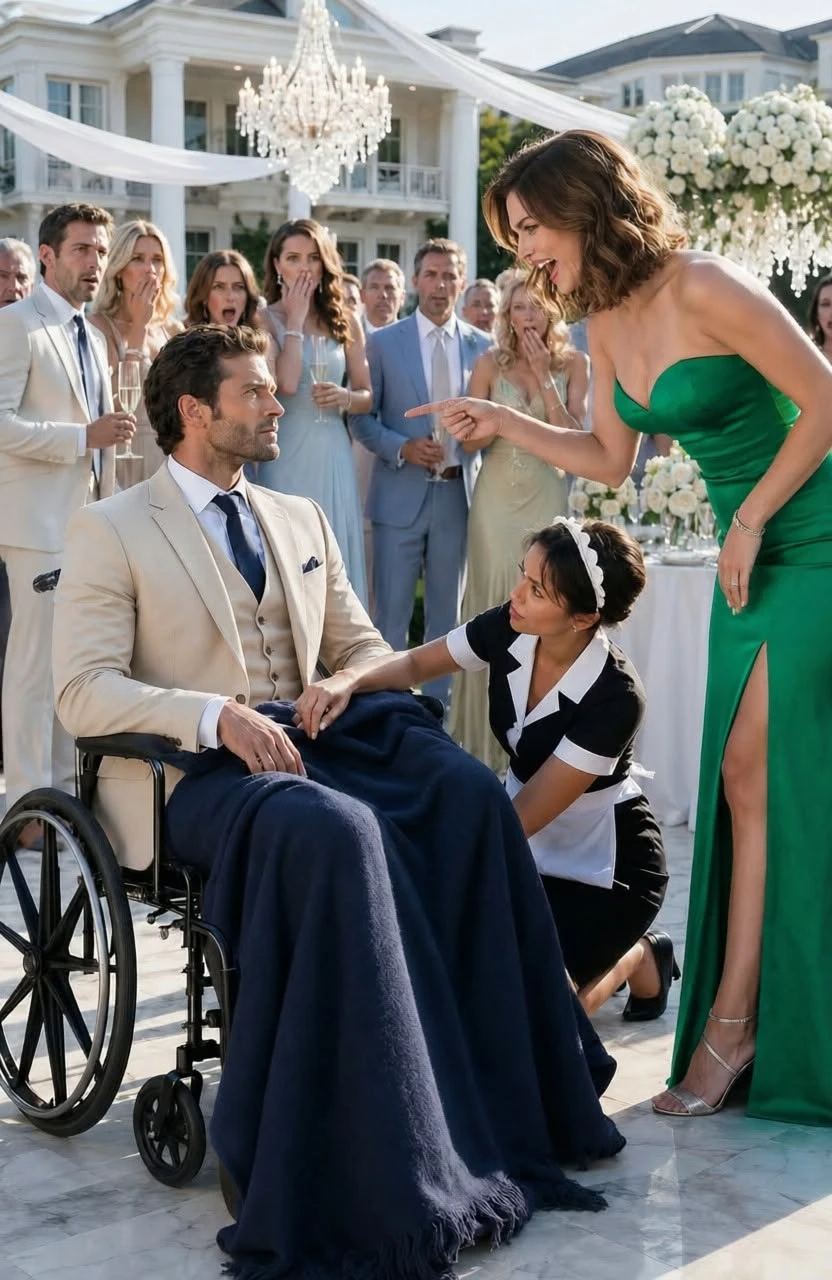
I pretended the accident had broken my bones, so I sat silently in my wheelchair and watched my fiancée laugh mockingly in front of everyone. “Look at you,” she sneered, leaning closer.
“Now you’re nothing—just a useless cripple.” No one defended me. Only the maid knelt beside me, adjusted the blankets, and whispered, “You still deserve to be treated kindly.” That was when I finally realized who truly mattered in my life.
The first time my fiancée called me useless, the whole room laughed. The second time, I decided to let them keep laughing.
I sat in the center of my father’s grand ballroom, wrapped in a gray blanket, my legs hidden beneath it, my hands resting weakly on the wheels of my chair. Crystal chandeliers burned above us. Champagne glasses glittered. Everyone had come to “welcome me home” after the accident that supposedly shattered my spine.
Only I knew the truth.
My bones were fine.
The crash had been real, but the injury was not. My doctors, my lawyer, and my security chief knew I could stand. Everyone else believed what I wanted them to believe.
Especially Vanessa.
She swept toward me in a silver dress, her diamond engagement ring flashing like a weapon. Behind her, my cousins, business partners, and social-climbing friends watched with cruel curiosity.
“Look at you,” she sneered, leaning close enough for me to smell wine on her breath. “Now you’re nothing—just a useless cripple.”
A few people gasped. No one defended me.
My uncle Martin looked away. My best friend Daniel lowered his eyes. Vanessa’s mother actually smiled.
I kept my face blank.
Vanessa tapped my blanket with one manicured nail. “I was supposed to marry a powerful man. Not a burden.”
“Vanessa,” I said quietly, “we are still engaged.”
She laughed. “For now. Until your board realizes you can’t even walk into a meeting.”
That sentence told me everything. She was not grieving me. She was waiting for my empire to collapse.
Then someone knelt beside me.
It was Clara, the young maid who had worked in our house for three years. She adjusted the blanket Vanessa had kicked aside and whispered, “You still deserve to be treated kindly.”
Her voice was soft, but it cut through the noise like a bl::ade.
Vanessa rolled her eyes. “How touching. The servant pities him.”
Clara lowered her head, but she did not move away.
I looked at her hand on the blanket—steady, gentle, brave. In that moment, I remembered every time she had brought medicine without being asked, every time she had spoken to me like I was still human, every time she had watched Vanessa with quiet fear.
And finally, I understood.
The accident had not broken me.
It had revealed them….
Three days later, Vanessa began planning my removal from my own company.
She thought I was trapped upstairs in my bedroom, helpless beneath silk sheets and expensive lies. She did not know there were cameras in the library, microphones in the study, and a private elevator that opened into my security room.
May you like
At midnight, I watched her on six monitors.
She stood beside Daniel, my so-called best friend, pouring whiskey with a smile sharp enough to cut glass.
“He won’t last,” Daniel said. “The board will panic.”
Vanessa laughed. “Good. Once I marry him, I’ll push for medical guardianship. Then we transfer voting power. After that…” She lifted her glass. “Poor Adrian can recover in some quiet facility.”
My jaw tightened.
Daniel leaned closer. “And the maid?”
Vanessa’s smile vanished. “Fire her. She looks at him like he matters.”
I saved the recording.
The next morning, Vanessa entered my room carrying flowers like a performance. Clara stood near the window, folding towels.
“My poor darling,” Vanessa said loudly, in case anyone was listening. “I’ve spoken to a specialist. A private care center. Very peaceful.”
I looked up. “You want to send me away?”
“For your own good.” Her eyes flicked toward Clara. “And we’ll need to reduce staff. Some people are getting too attached.”
Clara’s fingers paused.
Vanessa stepped closer to her. “Pack your things by tonight.”
“No,” I said.
The room went silent.
Vanessa turned slowly. “Excuse me?”
“Clara stays.”
Her face hardened. “You don’t give orders anymore, Adrian.”
I let the silence stretch. Then I smiled faintly.
That was the first time fear touched her eyes.
She recovered fast. “Fine. Keep your little maid. It won’t matter.”
But it did matter.
Because Clara had already found something.
That evening, she slipped into my room holding a torn envelope. “Sir… I found this in Miss Vanessa’s trash.”
Inside were copies of forged medical documents, a draft guardianship petition, and emails between Vanessa, Daniel, and a board member named Pierce. They had planned to declare me mentally incompetent.
At the bottom was a payment receipt.
The doctor they had bribed was not my doctor.
It was the man who had signed my false injury report.
They thought they had trapped a broken man.
They had actually handed evidence to the majority shareholder, CEO, and legal owner of every asset they were trying to steal.
I looked at Clara. “Are you afraid?”
She swallowed. “Yes.”
“Good,” I said softly. “Then you understand what they should be.”
By sunrise, my lawyers had the files. By noon, my security team had locked every executive server. By evening, I invited everyone back to the ballroom.
Vanessa arrived smiling, dressed in white, thinking it was an engagement announcement.
In a way, it was.
Just not hers.
The grand ballroom of the Sterling Estate was transformed. What had been a celebration of social status three days prior had been converted into a theater of judgment. The same crystal chandeliers that had shimmered above Vanessa’s silver dress now cast a harsh, clinical light over the faces of the assembled guests. They sat in velvet chairs, a sea of bewildered faces—business associates, board members, and the sycophants who had cheered for Vanessa’s cruelty.
Vanessa swept into the room, her stride confident, her face radiant. She was draped in a floor-length white gown, an engagement white—the kind of color a woman wears when she is moments away from absolute victory. She scanned the room, looking for me.
I sat in the center of the stage, my wheelchair still positioned prominently, the gray blanket draped carefully over my legs. My security chief, Marcus, stood at the edge of the stage, his hand resting near his side, his eyes scanning the crowd with the precision of a hawk.
Clara stood off to the side, near the shadows of the velvet curtains. She looked small, but when our eyes met, I saw the steady, unwavering resolve that had saved my life—and my soul.
“Adrian!” Vanessa called out, her voice melodious and saccharine. She walked toward the stage, ignoring the strange, oppressive silence that hung over the room. “Darling, what is this? A meeting at this hour?”
She reached the stage and placed a hand on my shoulder, leaning in to whisper, “If you’re trying to stage some dramatic announcement about your health, you’re making a fool of yourself. Daniel is ready in the back. Just finish this.”
I didn’t answer. I reached into the side pocket of my chair and pulled out a small, metallic remote. With a subtle click, the massive high-definition screens mounted on the walls of the ballroom flickered to life.
Vanessa blinked, turning toward the screens. The audio began to play—clear, amplified, and damning. It was the recording from the library.
*“He won’t last. The board will panic.”* Daniel’s voice echoed throughout the hall.
Vanessa’s laughter followed on the recording. *“Good. Once I marry him, I’ll push for medical guardianship. Then we transfer voting power. After that, poor Adrian can recover in some quiet facility.”*
The room erupted. The murmurs weren’t of sympathy; they were of shock, followed by a cold, hard realization. The socialites who had ignored me in the wheelchair now stared at Vanessa with the eyes of predators.
Vanessa’s face drained of color. She spun toward me, her eyes wide, her poise crumbling like a sandcastle in a storm. “Adrian… that’s… that’s a deepfake. That’s technology, it’s not real!”
“It is very real, Vanessa,” I said, my voice cutting through the hall with the weight of steel. I placed my hands on the armrests of my chair.
The entire room seemed to hold its breath.
I leaned forward, then, with a slow, deliberate movement, I planted my feet firmly on the floor. I stood up.
I stood straight, my spine perfectly aligned, my strength radiating through the room. I was not the broken man she had mocked. I was the CEO she had tried to erase, and I was entirely whole.
Vanessa recoiled, stumbling back as if I had struck her. “You… you can walk?”
“I have always been able to walk,” I said, stepping off the stage and onto the ballroom floor. “I simply chose to see who would try to step over me when they thought I was down.”
The aftermath was a hurricane of litigation and exposure. By the time the clock struck midnight, the narrative of the Sterling Empire had shifted entirely.
The board members who had been swayed by Vanessa and Daniel were now scurrying to distance themselves. My lead counsel had spent the last six hours filing lawsuits that targeted not just Vanessa, but the entire network of collaborators she had woven around my company.
I sat in my study, watching the city lights flicker in the distance. The door opened, and Clara entered. She didn’t approach with the timid gait of a maid; she walked with the confidence of someone who knew her worth.
“Sir,” she said, setting a tray of tea on the mahogany desk. “The lawyers have left. The police have taken Daniel into custody.”
I looked at her, truly looking at her. Beneath the uniform, I saw a woman who had seen the worst of humanity and had remained kind. “Why did you do it, Clara? Why did you stay when she told you to leave? Why risk everything for a man you thought was paralyzed?”
She paused, her gaze lingering on the window. “I have worked in many houses, Mr. Sterling. I have seen many powerful men. But when I brought you your medication, you never looked through me. You always said ‘thank you.’ You never let your status change your humanity. That, to me, is the only kind of strength that lasts.”
I felt a pang of regret for every day I had been too distracted by Vanessa’s vanity to notice the people who truly mattered. “That kindness,” I said, “was the most expensive thing I ever bought, and yet, it was the only thing I didn’t have to pay for.”
“What will you do now?” she asked.
“I will rebuild,” I said. “But not just the company. I am rebuilding this home.”
The next morning, Vanessa’s mother attempted one final confrontation at the front gates. She screamed about contracts, about social standing, about the humiliation of her daughter. I didn’t meet her. I let Marcus handle it. He handed her a single document: an eviction notice and a demand for the repayment of every cent she and Vanessa had siphoned from the estate under false pretenses.
I walked into the ballroom one last time. The space felt empty, purged of the ghosts of people who had only ever looked at me as a bank account.
I found a notebook on the stage where Vanessa had left her planning documents. It was filled with lists—lists of people to discard, assets to sell, and ways to alienate me from my own family.
I tossed it into the fireplace.
As the pages curled into ash, I heard footsteps behind me. It was Clara. She was no longer wearing the maid’s apron. She had resigned, of course, but I had insisted she stay as a consultant—someone to oversee the transition of the household.
“The house feels different today,” she observed.
“It is different,” I replied. “The rot has been removed.”
“And what about you, Adrian?” she asked, using my first name for the first time. “Are you still the man who needs to play games to see who loves him?”
I turned to look at her. The question was sharp, but it was honest. “No,” I said. “I think I am done with games. I would like to live a life where I don’t have to test the people around me.”
She smiled, a slow, genuine expression that transformed her face. “That’s a good start.”
The following weeks were a whirlwind of corporate restructuring. I stripped the board of the dead weight, replacing cronyism with merit. I turned the medical foundation—the one Vanessa had intended to use to declare me incompetent—into a legitimate institution dedicated to actual rehabilitation, funding the very research that could help people who were truly disabled.
I didn’t forget the lesson. Every morning, I woke up in a house that was no longer a cage. The silence was no longer heavy; it was peaceful.
One afternoon, I found Clara in the garden, looking at a bed of roses that had been neglected for years.
“You know,” she said, pointing to a wilted stem, “if you prune the dead weight, the plant grows twice as tall.”
“I’m learning that,” I said, coming to stand beside her.
We walked through the estate, the gardens vast and green. I found myself telling her things I had never told Vanessa—my dreams for the future, the fears I had about my father’s legacy, the desire to do something that actually helped people. She listened, not as a subordinate, but as an equal.
I realized then that the accident, while fabricated, had led me to the most important truth of my life: that I had been blind, not to my physical surroundings, but to the value of human character.
The socialites who had laughed at me in the ballroom eventually came crawling back, offering apologies, inviting me to dinners, trying to worm their way back into the graces of the man who now held even more power than before.
I refused every single one of them.
“Why?” my lawyer asked me one day. “Some of these people are the most powerful in the state.”
“Because,” I said, looking at the invitation cards sitting on my desk, “they aren’t powerful. They are just loud. And I have spent enough time in my life listening to people who have nothing to say.”
I looked at Clara, who was organizing a new filing system in the office. “Clara, do you ever miss the way things were?”
She shook her head. “I miss the simplicity of a quiet life, but I think this is better. You are finally awake.”
“Yes,” I said, feeling a weight lift off my chest. “I am.”
The empire was thriving. The board was loyal. My health was peak. But more than anything, my life was mine again.
I realized that Vanessa hadn’t just been trying to steal my company; she had been trying to steal my identity. She wanted me to be the person she saw in her mind—a man who was weak, a man who was controllable, a man who was alone.
But she had failed.
I turned to the window. The garden was beginning to bloom. The roses were starting to grow, just as Clara had said they would, once the dead weight was cleared away.
I picked up the phone and dialed my lawyer. “Cancel the board luncheon. And clear my schedule for the rest of the week.”
“What are you going to do?” he asked.
“I’m going for a walk,” I said. “Without a wheelchair. And I’m going to enjoy the fact that I can move in any direction I choose.”
I hung up and looked at Clara. “Are you busy?”
She looked at the files, then back at me, and smiled. “No.”
“Good. Let’s go for a walk.”
We walked out into the world, leaving behind the ghost of the man in the chair, and stepping into the life of the man who finally knew exactly who was standing beside him.
The ballroom, with its crystal chandeliers and silver dresses, was a world away. I didn’t need the glitter. I didn’t need the masks. I just needed the truth. And for the first time, the truth was something I could build a life on.
As the seasons changed, the Sterling Estate underwent a complete metamorphosis. The cold, sterile aesthetic that Vanessa had insisted upon—the marble floors, the velvet curtains, the gray palettes—was replaced by warmth, color, and life.
I spent my evenings reading in the library, not checking security monitors, but reading books I had neglected for years. I spent my days in the office, but instead of focusing on how to maintain power, I focused on how to distribute it, creating opportunities for those who had been overlooked, just as I had been.
One evening, I found myself in the garden, looking at the city skyline. The lights of Philadelphia burned bright. Somewhere out there, Vanessa was living in a cramped apartment, likely trying to find the next target for her ambitions. I didn’t hate her anymore. Hating her would have been a waste of energy. She was simply a lesson, a footnote in a book that I was currently writing.
Clara approached me, holding a letter. “This came for you, Adrian. It’s from the board of directors of a charitable foundation. They want you to be their keynote speaker.”
I took the letter and set it on the garden table. “I don’t know if I’m the right person for that.”
“You are,” she said. “You’ve lived through a lie and found the truth. That is exactly what they need to hear.”
I looked at her. “I couldn’t have done this without you, Clara.”
She stood still, her silhouette framed by the setting sun. “You could have. You just needed to realize that you didn’t have to do it alone.”
I realized she was right. My strength had been there all along, but her presence had been the catalyst. She was the one who had stood by me when I was at my lowest, the one who had seen me as a human being rather than a broken instrument.
“Clara,” I said, “would you like to be the director of the foundation? I don’t mean a consultant. I mean the director. You have the heart for it, and you have the vision. The staff needs someone who knows what it’s like to work in the shadows but still have the light to lead.”
She looked at me, surprised. “I don’t have the degree for that, Adrian.”
“I don’t care about degrees,” I said. “I care about experience. And I care about the fact that you know the value of kindness.”
She stayed silent for a long time. Then, she nodded. “I would like that.”
The transition was seamless. Clara became the most effective director the foundation had ever had. She transformed it into a space that truly helped people, a place that mirrored the change I had made in my own life.
Life became a series of quiet victories. The company expanded, but with a different ethos. The employees were treated with respect, the workplace was no longer a theater of fear, and I found myself actually enjoying the work.
I was no longer the man in the wheelchair. I was no longer the puppet of a woman who didn’t exist. I was Adrian Sterling, a man who had built his own world and chose to fill it with the only people who had ever really seen him.
Sometimes, when I looked in the mirror, I saw the man I was before the accident—the man who was so busy being successful that he had forgotten how to live. And I thanked the universe for the crash. Because the crash had destroyed the life I thought I wanted, and in the debris, I had found the life I truly deserved.
The ballroom was still there, but it was no longer a ballroom. It was an auditorium for the foundation, a place where people gathered to talk about real life, real struggle, and real hope. It was a space that was no longer cold.
I stood at the back of the auditorium during one of Clara’s speeches. She looked so composed, so powerful. I felt a surge of pride that was far greater than any I had ever felt when I was signing corporate mergers.
She finished her speech and walked toward the back of the room, finding me. “How was it?”
“It was perfect,” I said.
“Better than the ballroom?” she teased.
“Much,” I said.
We walked out of the building and into the cool evening air. The city was alive with noise, but here, in the shadow of the estate, it was quiet.
I looked at the house. It was just a house. A structure of stone and glass, but it was filled with something that had never been there before: genuine, honest connection.
“Are you happy, Adrian?” Clara asked as we walked toward the garden gate.
I looked at the stars above, then down at the path beneath my feet. My legs were strong. My heart was steady. And the woman standing beside me was the only person in the world who understood the journey I had taken.
“I am,” I said. “For the first time in my life, I am exactly where I need to be.”
And as I walked into the night, I knew that the accident, the wheelchair, the lies—they were all just a part of the story. But they weren’t the end of it. The end of the story was this moment. The end of the story was the realization that while I had once been broken, I had spent the rest of my life becoming someone who was whole.
I had been defined by what people thought of me, but I was now defined by what I knew about myself. I was Adrian Sterling, and I was finally home.
The years that followed were defined by a steady, deliberate growth. The Sterling Foundation became a beacon of innovation and compassion, and under Clara’s leadership, it expanded across the region, changing lives in ways I had only dreamed of when I was trapped in my own ambition.
I became known not as the reclusive billionaire who had survived a tragic accident, but as the CEO who had redefined the meaning of corporate responsibility. The media tried to dig into the past—they tried to write books about the “scandal of the ballroom”—but I refused to engage. I didn’t need to control the narrative anymore. The results of our work were the only story that mattered.
Vanessa, meanwhile, became a ghost. I heard reports that she had moved to a different city, trying to recreate the same social life that had been so easily shattered. But people remembered. The internet is a permanent archive, and every time she tried to ascend, the video of the driveway—of her mocking a child, of her mocking me—was there to pull her down. It was a heavy price, but it was a price she had chosen to pay.
I often thought about that night in the library. I thought about the man I was—the man who would have been destroyed by her betrayal if I hadn’t taken the time to see what was really happening.
I realized that power wasn’t about the control of others. It was about the control of oneself.
One day, while reviewing the foundation’s annual reports, I saw a familiar name in the donor list. It was Daniel. My former friend. He had served his time, and now he was working in a modest position at a community center. He had sent a donation, not a large one, but a meaningful one, with a short note attached.
*“I’m sorry for the man I was. I hope the foundation continues to do the work I wasn’t brave enough to do.”*
I didn’t respond, but I didn’t destroy the note either. It was a sign of change. People could change. The accident had taught me that. We are not just the sum of our worst moments; we are the sum of the choices we make after those moments occur.
I walked into the office and found Clara looking at the reports.
“He sent a donation,” I said, handing her the note.
She read it and looked up. “Do you think he means it?”
“I think he’s trying,” I said. “And for him, that’s a beginning.”
We stood there for a moment, the quiet hum of the office surrounding us. It was a good life. It was a life of purpose, and more importantly, it was a life of truth.
I thought about the wheelchair in the corner of the attic, stored away like a souvenir. I would never sit in it again, but I would never forget it. It was the tool that had allowed me to see the world from a different perspective, and in doing so, it had saved me.
“What are you thinking about?” Clara asked.
“I was thinking about how much I’ve changed,” I said.
She walked over to the window and looked out at the city. “You didn’t change, Adrian. You just stopped hiding.”
I took her hand. It was the same hand that had rested on the blanket that night in the ballroom—steady, gentle, and brave.
“Maybe,” I said. “But I think I had to hide for a while to find out who was worth coming out for.”
The work continued. The foundation grew. The house remained a sanctuary. And every morning, I woke up with the realization that the life I was living was the life I had earned.
It wasn’t a life of silver dresses or diamond rings. It was a life of substance. And as the sun rose over the city, casting a warm light across the office, I knew that no matter what happened next, I was ready. Because I was no longer afraid of the ballroom. I was no longer afraid of the shadows. I was simply here, standing tall, moving forward, and grateful for every single step of the way.
The accident had revealed the truth, but it was the truth that had set me free. And that was the greatest success I would ever achieve.
The Sterling Estate was no longer just a house. It was a home. It was a place where people were valued for their character, not their connections. And as I looked at the desk, at the files, at the life I had built, I realized that I had finally found what I was looking for all along: a reason to be, a reason to lead, and a reason to be kind.
And that, in the end, was all that mattered.
As the years blurred into a decade, the Sterling Foundation became a global entity, setting standards for ethics in business and compassion in leadership. We opened hospitals, funded research, and created scholarships for children who had been overlooked by the traditional systems.
I stood at the podium in a massive hall, not the ballroom of my estate, but a convention center in the heart of the city. Thousands of people were listening. I didn’t have a script. I didn’t have a PR team. I just had my voice.
“We are often told,” I began, “that success is measured by what we acquire. That power is measured by who we can control. That strength is measured by how much we can withstand. But I stand here today to tell you that all of those things are lies.”
The room was silent, every person hanging on my every word.
“True success,” I said, looking out into the crowd, “is the ability to remain kind in a world that asks you to be cruel. True power is the courage to stand for those who have no voice. And true strength? True strength is the ability to walk away from a life that doesn’t belong to you, and to build one that does.”
I thought about the night in the ballroom. I thought about the feeling of the blanket on my lap, the weight of the wheelchair, the sneer on Vanessa’s face. And I realized that if I could go back and change that night, I wouldn’t. I would let it happen all over again. Because that night was the beginning of everything.
“We are all broken in some way,” I continued. “But it is in the breaking that we find out who we really are. Don’t be afraid of the accident. Don’t be afraid of the fall. Be afraid of the life you’ll lead if you never find the courage to stand up.”
The applause was thunderous, but it wasn’t the sound of the ballroom. It was the sound of a thousand people who understood exactly what I meant.
After the speech, I walked out into the cool evening air, Clara beside me.
“You did well,” she said.
“I just told the truth,” I replied.
We got into the car and drove back toward the estate. The city lights were a blur of motion, a reminder of the thousands of lives that were changing because of the foundation.
“Do you remember the first time I saw you?” I asked.
“You mean when you were in the wheelchair?” she asked.
“No,” I said. “I mean when I first noticed you. It was in the kitchen. You were folding towels. You didn’t even know I was watching.”
She laughed. “I was thinking about whether or not I had finished the laundry.”
“I was thinking about how much I wanted to be like you,” I said.
She looked at me, surprised. “Like me? You were the CEO of a multi-million-dollar empire.”
“And you were the only person in that house who was truly free,” I said.
We drove in silence, the engine of the car the only sound in the dark.
I realized then that life wasn’t about the finish line. It was about the people you walked the path with. And I was lucky. I was the luckiest man I knew.
I arrived home and stepped out of the car. The house was waiting, warm and inviting.
“I think I’m going to go for a run tomorrow morning,” I said.
Clara smiled. “I’ll join you.”
“I’d like that,” I said.
And as I walked through the door, leaving the noise of the world behind, I felt a sense of peace that I had been searching for my entire life. The ballroom was gone, the lies were gone, the broken man was gone.
What remained was the truth. And in the truth, I had found my home.
The morning sun hit the bedroom floor, a warm, golden light that signaled the start of a new day. I woke up and stretched, feeling the strength in my limbs, the clarity in my mind, and the absolute absence of any doubt.
I walked to the window and looked out at the garden. The flowers were in full bloom, a vibrant display of life that mirrored the growth I had experienced in my own heart.
I put on my running shoes and headed out the door. The air was cool and crisp, the perfect temperature for a run. As I jogged down the path, I saw Clara waiting for me at the garden gate.
“Ready?” she asked.
“Ready,” I said.
We began to run, our pace steady and synchronized. The rhythm of our footsteps on the pavement was a reminder of how far we had come. We ran past the gates of the estate, into the quiet streets of the neighborhood, and toward the park where the city began to wake up.
I saw a man sitting on a park bench, watching the sunrise. He looked tired, his shoulders slumped, his eyes focused on the ground. I slowed my pace and stopped.
“Are you okay?” I asked.
The man looked up, surprised. “I’m just… I’m tired of trying.”
I looked at him, and for a moment, I saw myself in the wheelchair. I saw the fear, the doubt, the feeling that the world was waiting for me to fall.
“I understand,” I said. “But you don’t have to do it alone.”
I reached into my pocket and pulled out a card for the foundation. I handed it to him. “There are people there who know what it’s like to start over. Give them a call.”
The man took the card, his hand trembling slightly. “Thank you.”
“You’re welcome,” I said.
Clara and I continued our run, the morning air filled with the promise of a new beginning for someone else.
I realized that my story wasn’t just about my own journey. It was about the way I could use that journey to help others. My life was no longer about the accumulation of power, but the distribution of hope.
We finished the run and returned to the estate. The kitchen was warm, the smell of fresh coffee filling the air. It was a simple, everyday moment, but it was perfect.
“You made a difference today,” Clara said.
“We did,” I corrected.
I sat at the table, looking out at the garden, and I realized that I had finally found what I was looking for. I didn’t need the ballroom. I didn’t need the crowd. I just needed the truth, and the people who were willing to share it with me.
The journey was not over. It was just beginning. There were more people to help, more stories to be told, and more mornings to be lived. And I was ready for every single one of them.
I drank my coffee, feeling the warmth of it spread through my chest, and I smiled. It was a good day to be alive. It was a good day to be me. And most of all, it was a good day to be free.
As the sun sets on the Sterling Estate, I stand on the terrace and look out over the city. I am older now, my hair touched with silver, but my spirit is younger than it has ever been.
The lessons of the past have become the foundations of the future. The wheelchair is a symbol of the strength I found in the fall. The ballroom is a symbol of the superficiality I left behind. And the estate—this home—is a symbol of the life I chose to build.
People often ask me what I would change if I could. They ask if I regret the time I spent with Vanessa, or the bitterness I felt after the accident.
I tell them no. Because everything that happened had to happen for me to get to this point.
I had to be broken to be rebuilt. I had to be betrayed to understand loyalty. I had to be in the dark to appreciate the light.
Clara walks out onto the terrace and stands beside me. We watch the sun disappear behind the horizon, the sky a tapestry of colors that no artist could ever capture.
“It’s a beautiful evening,” she says.
“It is,” I agree.
I take her hand and look out over the vast expanse of the city. I see the lights of a thousand different lives, each one a story of struggle, each one a story of hope. I know that I will never reach them all, but I am committed to reaching as many as I can.
“What are you thinking about?” she asks.
“I was thinking about how little it takes to make a difference,” I say. “A word of kindness, a moment of truth, a decision to be better than you were yesterday.”
She smiles, that same smile that has guided me through the darkest and brightest moments of my life. “That’s what you’ve done, Adrian.”
“No,” I say. “That’s what we’ve done.”
And as the stars come out, one by one, filling the night sky with their soft, steady light, I know that my story is finally, truly, my own. I have moved past the ballroom, past the betrayal, past the man in the chair. I have become the architect of my own destiny, and I have found the one thing that money could never buy: a life lived in truth.
The estate is quiet, a sanctuary in the heart of the city. And as I turn to walk back inside, I know that tomorrow will be another day to lead, another day to help, and another day to live. And for the first time in my life, I don’t need to be powerful. I just need to be myself.
The accident didn’t break me. It made me. And I have never been more grateful for that.
I step into the warmth of the house, the light following me in. The door closes behind me, and I know that I am finally, truly home.
And that is where I will stay.
For the rest of my life.
- At the family reunion in front of 50 relatives, my dad put his arm around me and introduced me as ‘the mistake we kept
- My mother actually smiled when the officer reached for his handcuffs. Tiffany kept her livestream aimed at me like she had been waiting years to capture my humiliation
- My wealthy husband brought an elderly homeless woman into our mansion and gave me an order I never expected to hear.
- During labor, my husband begged me to moan more quietly, then left me alone with our triplets and went on vacation because the birth was “too stressful” for him
- PART 2: The Day Genevieve Chose What Home Meant7 026
